Wednesday, 7 January 2015

Critical Reflection Module 2

Reflecting on Module 2  has highlighted the development and progresses I have made since module one. Creating my inquiry proposal has given me an in-depth focus and drive to undertake my inquiry with confidence and excitement.

Module 2 has allowed me to continue developing skills learnt in module 1 including Networking and web 2 based programmes with the creation of my SIG and initial conversations with possible participants. I have also found myself referring back to many theories which I was unaware of before completing module 1.

Development of possible lines of inquiry involved reflecting on Module 1 and investigating information and theories on inquiry. From there I was able to accumulate a list of started questions (Appendix A). From discussion on my SIG community and conversations with fellow professionals a smaller number of more define questions emerged. For me a key part of deciding on my Line of inquiry was Literature, what was already known about my questions and was there a need for an inquiry on the subject? (Appendix B, Appendix C). I realise how vital it is to really know and understand your subject in depth to gain the most from your line of questioning.

As my inquiry will be based in  a primary School and observations will be made involving participants under 16 years old understand Ethics is essential. Module 2 gave me the knowledge and background to further develop my understanding to ensure all bases will be covered (Appendix D). I had to pay particular attention to Ethics when making decisions on which inquiry tools would be most successful and suitable, understanding any potential risks and how to avoid them. After researching several methods I feel confident my choices will be successful. Constructing Information sheets, Informed consent forms and Ethical statements have helped me to built a strong Ethical base to begin my Inquiry (Appendix E).

Overall Module 2 has given my the confidence to go forward with my Inquiry. I feel I am a lot more aware and knowledgeable regarding ethical considerations and the importance of knowing your 'subject'. The module has enabled me to streamline thoughts and become more focused on detail within my work. I look forward to developing my research, literature knowledge and finally start constructing my Inquiry in Module 3!


Bibliography
 
Alexander, Rose, Woodhead 1992) - http://dera.ioe.ac.uk/4373
 
Bandura 1997 – Social Learning Theory
 
Bell 2005
 
Bresler, Illinois, 1990
 
Caldwell. B 2013 The Benefits of Arts in the Curriculum


Thinking inclusion  IQM Blog -  Inclusion Quality Mark Ltd (IQM) Posted by  'Chris' On June 1st 2014 http://www.inclusionmark.co.uk/blog/index.php/examination-or-assessment/


Tuesday, 6 January 2015

Inquiry tools Questionnaire pilot


One of the tools I have decided to use for my inquiry is a Questionnaire, I feel this particular tool is useful not only to gain quantitative data but also to gain an insight in to more specific questions which could be used during face to face interview to further investigate information already sourced. 
I sent me pilot through email to a small number of colleagues,  a 'generalized' primary teacher and a specialized Dance coach I felt this would give knowledge on appropriate avenues to peruse with regards to participants and suitable questions. Having previously discussed the questionnaire with both colleagues I asked for relevant feedback regarding questions and any suggestions on new more appropriate lines of questioning.
Primary teacher response in Red 
Dance coach response in Blue
 
 1.  How do you believe your personal energy and mood affects others/pupils during class?   
My personal energy and mood really affects the other adults and pupils in my class.  If I am excited and eager to teach a lesson and am interested in the lesson and show this to the children then they become more engaged and interested in the lesson too.  Likewise if I am miserable or show lacking interest then the children will pick up on this and not engage as well in the lesson.  The mood and atmosphere I create in my classroom affects all those in it and how the lesson goes.

If people are lacking energy it gives off a 'cant be bothered' attitude and this will rub off onto other pupils and the quality of work will decrease. Staying positive and energetic encourages others to work harder.


2. What do you believe to be the most effective ways for your Children/ adults to learn?  

I believe the most effective ways of children to learn is by actively doing and taking part, they must also take responsibility for their own learning and ask questions and explore their thinking further. Children learn best wen they are allowed to ask questions, take risks and solve problems.  Collaboration with others is also vital to allow them to talk through their thinking, share ideas and communicate.

Making sure that work is achievable for all members of the class, therefore catering to all abilities but still challenging so pupils don't get bored. I also believe it is most effective to learn routines in stages, so as not to confuse students with too much to fast, break it down.


3. Do you feel exams/ performance situations relate to a child's progress and development within dance?  
N/A

Not always. Some children will embrace these situations and perform very well showing their skills, however others may find performance and exams a stressful situation and do better in classes. I think it is important to track a child's progress in lessons as well as exams and performances
 

4. Do you see a difference between children who participate in exams and performance situations and those who do not?
Children who participate in different performance situations are generally more confident. They are able to communicate well with adults and peers alike and are keen to take risks and a lead in different situations.

Children who participate in performances are often more confident with their dancing. However, this is not always the case. All children are different so it is difficult to say


5. In your opinion what teaching styles/strategies help to guarantee the retainment of Choreography/information and a child's learning?
N/A

I believe the more fun children are having the more likely they are too remember. As well as this i think that they will find it easier to retain moves that they have been able to develop or customise themselves.
 

6. When delivering a one day dance workshop in a school environment who should be the main disciplinarian...the main school teacher or the visiting facilitator? Why?
I believe the visiting facilitator should take control of the class and discipline where necessary.  As a teacher I would find it undermining if someone were to discipline children in my class when I was teaching and so I would expect the person delivering the lesson to discipline when needed. This allows for a smoother running lesson and also show the children the visiting facilitator has the same authority. However if there was a need or a particularly challenging class or child then I would expect the class teacher to support the facilitator in discipline.


I believe the visitor should obviously be able to discipline, however the main school teacher will have knowledge of the school discipline system the child is used to, which would be more effective. So I think minor things should be left to the visitor to deal with but the school teacher should be close by to deal with more serious behaviour.
7.  Do you think dance plays an important role in mainstream education?

Dance plays an important role in mainstream education.  It is a key area of the PE national curriculum and allows children to express themselves in a different way. It also allows children to develop their coordination and rhythm. It is also a great performance tool to develop confidence when performing to an audience.  Dance is not only incorporated into PE at my school but also into school plays, nativity plays, assemblies and an annual may time dance!

I don’t believe it is a core subject but i do think its important to do the same as any other form of exercise. Some children may be unable to attend dance classes outside of school so being able to participate in dance lessons at school is very good for them, especially if it encourages them to pay attention more and excel in something they are good at.

 
8. What are your feelings on the Primary and Secondary dance curriculums, are there any ways in which you think dance could be developed within the curriculum?

The new primary curriculum for PE is extremely brief and does not give enough information about dance.  We use a variety of schemes or dance experts to help create a dance curriculum to be followed during PE sessions at my school. 

I don’t know much about the current curriculum for dance. However I am glad dance is now being seen as its own subject for children to study.


Award title

I have chosen 'BA (Hons) Professional Practice (Dance Teaching) ' for my award title. I believe this identifies my current position and my hope to develop further as a teacher.

My journey began with the hope to become a professional Dancer, I trained for 3 years at Bodyworks in Cambridge studying many genera's of dance. Whilst training I decided to look into teaching and successfully completed a NATD associate teaching qualification with Distinction. Once graduating I went on to work as a professional dancer and teacher delivering education dance workshops in primary schools across the country. In the past 2 years I have developed my own enrichment program which I deliver with the hope to encourage dance on a more regular basis within schools.
My studies have all been developed around my teaching and have been a great insight into how I can develop and improve.  In the future I hope to develop my career as a teacher with the possibility to gain a PGCE qualification.


My inquiry aims to demonstrate the Importance of Dance within the Primary Curriculum and the relevance of subject knowledge

Tuesday, 18 November 2014

Informed consent

Informed consent will be my one of my initial concerns as regards to ensuring all ethical basis are covered. I will gather consent from all participants before they take any part in the inquiry. This will ensure they know and fully understand exactly what the inquiry involves, any potential risks and there exact involvement before they agree to take part.
I will use an Information Sheet to provide my potential participants with information about the inquiry. This will include such information as...
  • My name, university & Inquiry concept.
  • Why I would like the particular participant/school to be involved.
  • Ensure they are aware that even if they agree to take part, they can change their mind at any time, without giving an explanation.
  • Inform that the inquiry will primarily be observation based and what the observation will involve.
  • Explanation on how the information will be used, stored and kept confidential.


Ethical Considerations

Safeguarding procedures, CRB, Codes of conduct all common place in an educational environment or in any environment involving children for that matter. 
Working with Children on a daily basis has given me a detailed insight into many ethical issues which have to be taken into consideration. As I am looking to base my inquiry within an Educational setting much of my research will take place in such an environment therefore there are many procedures which must be considered and be at the forefront of my inquiry including;

  • Correct & current permissions - Permission must be granted from both parents and teachers to include any photographic evidence or comments involving particular children and all faces visible must be depicted. Names of Schools or Children/Teachers will not be referenced unless such permission has been granted and the correct referencing applied.
  • Data collection - Any Data and relevant information collated will be kept and seen only by myself and used solely for the inquiry.
  • CRB - A current Enhanced CRB must be to hand at all times when in an educational environment to ensure current government standards are upheld.
  •  Professional conduct - To uphold professional standards at all times, ensuring work areas are safe and are a space of positive learning. Ensure particular schools behaviour strategies are enforced and maintained and my inquiry and research dose not disrupt students and their learning.
  • Duty of care/ safeguarding - to ensure any behaviours, altercations or allegations I believe to be harmful towards a Child are reported to a safeguarding personal immediately.
  • To enter my Inquiry with no prejudice or prejudgements as to ensure a fair and unbiased result.

Monday, 17 November 2014

The Importance of Dance within Education

Is there a need for dance within the national curriculum?
A question I believe needs a firm answer of YES!

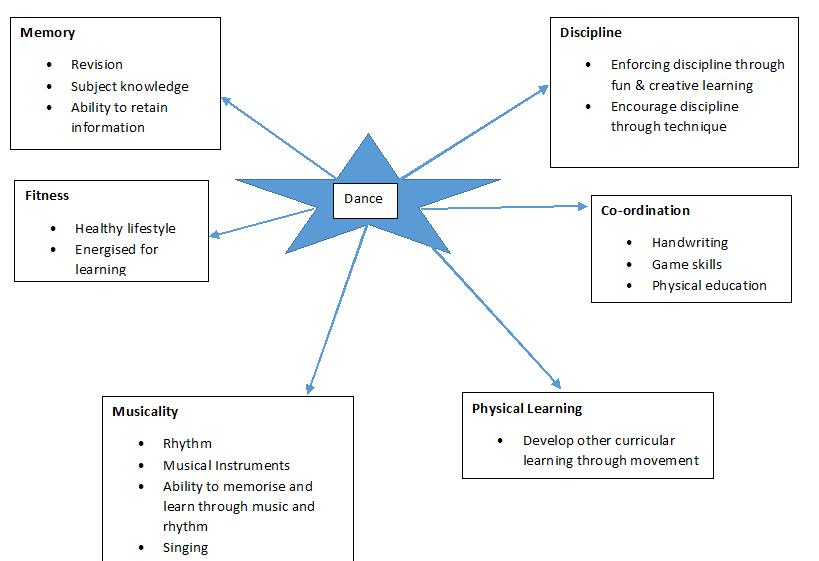
Just today I had a discussion with a Deputy Head who observed one of my lessons with a year 4 class. She expressed how she could see how beneficial Dance could be in aiding coordination, which not only helps with balance and physical movement but it crosses over into other subjects aiding Handwriting and presentation skills. This is just one of many reason why Dance can play a key part in the development of  a chid through education.


I decided to look for study's or pieces of research on the relevance Of Dance within the Education system as I feel this could be a great way to include many of my questions under one inquiry topic. I stumbled across a piece published in 1992 by Lynnette Young Overby ERIC Clearinghouse on Teacher Education Washington DC (http://www.vtaide.com/png/ERIC/Dance-in-Ed.htm) The research displays current (1992) percentages of participation, curriculum objectives and identifies barriers towards dance the schools may face.

 
''Dance is usually taught as a part of the physical education curriculum. In a survey of 31 state departments of education, 89% of elementary school dance was taught by physical educators (DeBryn, 1988). Secondary dance programs have been described as "understaffed, underfinanced, and unapplauded" (Posey, 1988). A recent nationwide survey of secondary schools found (a) the majority of dance classes are taught in physical education departments, and (b) the styles of dance most frequently offered are aerobic (45%), folk (11%), ballet (9%), social (8%), and creative or ethnic (7%) (Pappalardo, 1990).
At least 15 states have developed dance curriculum guidelines, including California, Florida, Georgia, Idaho, Illinois, Indiana, Michigan, Minnesota, Ohio, North Carolina, North Dakota, South Carolina, Texas, Utah, and Wisconsin (Hilsendager, 1990). Except for North Carolina, however, no states have mandates that the guidelines be implemented (Gingrasso & Stinson, 1989).
Many of the curriculum guides contain specific content, goals, objectives, and limited measurable outcomes for such areas as:
* Dance techniques for social, modern, and ethnic dance;
* Aesthetic perception;
* Kinesthetic sense;
* Creative expression;
* Choreography
Dance elements can also be integrated into other subject areas, which may increase the likelihood of dance being included in the school curriculum (Burke-Walker, 1989). Hanna (1992) provides an example of a physics class in which principles of momentum, force, velocity, and energy are applied to dance to improve dance performance. Franke (1989) identifies connections between writing, tennis, and dance.''
 
Another study Dance Education in Elementary Schools by Liora Bresler, an assistant professor in curriculum instruction at the University of Illinois 1987 to 1990, demonstrates issues still very much relevant today as regards to the fears general teaching professionals have when it comes to teaching dance...lack of subject knowledge, resources and advice.
 
''Not only did teachers have no knowledge base in dance or dance education, there was a lack of resources to help them become more knowledgeable. There were few dance education resources. And there seemed to be no vision of what a dance curriculum could be. The general sympathy that some teachers shared for dance was hard to translate into curricular activities and lesson units. The task of curriculum development in dance is compounded by its lack both of tradition and of availability of materials. Formal materials are rare. Videotapes or books that support learning objectives in dance are not easily accessible to teachers. Unlike the disciplines of music and visual arts education where there are textbooks, detailed methods, and lists of objectives, dance has few resources for curriculum planning. In the schools I studied, when it came to evaluation of student dance work, teachers had no preparation and no expertise to make artistic judgments. In this vicious cycle, there are few programs and resources from which to draw, few job opportunities, few materials designed for experts, and few professional organizations. These problems interact with the lack of budget, time, and priorities within the schools, mutually shaping each other.''
 
When looking over study's and research I found few published within the last 10 years with specification on the importance of Dance within Education, I found many articles and opinion blogs on the subject but little factual research. I also felt many of the study's I did come across had been developed in the States as apposed to the UK ...I feel this could be a good direction to head my inquiry.

Friday, 7 November 2014

Sources of Literature part 1

When research different sources of literature which could possibly help develop and expand my initial inquiry thoughts my first port of call was to look at the syllabus first from a dance organisation  and secondly from a educational curriculum view as I though this could open up other possible though paths involving the syllabuses development over a number of years, interpretation and its effectiveness. Although I found a few general discussion forums/blogs etc. on the topic I couldn't find quite what I was looking for I therefore turned my attention to specific questions I had already developed to see if theses could lead me to a new line of thought of development. One of the questions that had popped up on a number of occasions during conversations with fellow teachers was the affect assessment and/or exams can have on a child...Are they a good indication of ability, how they affect a child's ability to progress, are they setting children up for a fall, or are they in fact they way in which we succeed? The article I found particularly interesting was not specific to Dance but around learning in general. I still feel it holds a great deal of substance and relevance me as I always look to educational styles of teaching to help develop my on styles and techniques. All teaching stems from a set goal in wanting the child to succeed. The article comments on the pressures of examinations and how ensuring confidence is installed in every child is key. 

The source was located from the Thinking inclusion  IQM Blog -  Inclusion Quality Mark Ltd (IQM) was established in the U.K in October 2004 with the objective of supporting both state and independent schools to become truly inclusive. The particular entry was posted by 'Chris' On June 1st 2014 http://www.inclusionmark.co.uk/blog/index.php/examination-or-assessment/
 
One particular point I found very relevant was a comment made on a child having the feeling of failure and feeling inferior. Undoubtable at some point or another there will be a child who lacks self confidence and self worth, as a teacher it is our responsibility to ensure this happens as little as possible. Within many teaching spaces words such as fail, lose, cant and failure are forbidden but is the fact that in place to learn we must fail in order to succeed? Is this not what a learning journey is all about? However the point of reinforce positive praise to motivate learning, not setting a child up to fail are also key elements a successful teacher must endeavour to achieve.
 
''In every classroom there is likely to be a group of children who feel inferior to their classmates, with some actively articulating their difficulty in learning. I can’t…. draw, dance, remember, calculate…I’m not as good as…..  Life is full of pitfalls and the ability to face these is often the real test. Schools should be places where learners can seek solutions with active guidance and support as needed. Is failing as good for the soul as some would make out? Or, on learning situations, should areas for development be the mantra?
 
Pass/fail; win/lose; good/bad; yes/no; success/failure; can/can’t.
 
If we allow regular, polarised usage of such words to colour and determine education, what is the subsequent impact on the learning journeys of young people?''
 
The above point emphasises why everyone teaches in a different way, although we many attempt to follow certain criteria and take on board advised teaching styles we all in fact find our own way and one which works for us and our children.

Although the article in the main is regarding Assessment and examination it touches on many different points as well which is why I really found it insightful and it gave my a whole new range of possible paths of enquiry. It lead me on to want to see if I could find an expert opinion on the role dance plays within the mainstream education system and how they themselves overcome some of the hurdles mentioned above.